Home Fault finding How a combi boiler works
Fault finding
How a combi boiler works
What happens, in order, on a heating call and on a hot water call. Learn the order and you know where to look when it stops.
How a combi works
What happens, in order, on a heating call. Learn the order and you know where to look when it stops.
One burner, two jobs
A combi heats the radiators, and it heats hot water straight off the mains through a plate heat exchanger. It does one at a time. A diverter valve sends the hot water from the main heat exchanger either round the radiators or through the plate heat exchanger. On most combis hot water wins: open a tap and the heating stops until it's closed.
The heating call, step by step
- Demand. The timer and room stat call. The PCB sees a switched live, or a low-voltage call from a digital stat.
- Pump runs. When the boiler is cold some run the pump on its own first, before they light. How long varies by model. A flow switch or pressure sensor proves water is moving, where one is fitted.
- Diverter on heating. On many boilers this is its rest position. Some hold it on hot water until the boiler warms up.
- Fan runs and is proved. A speed signal on modern boilers, an air pressure switch on older ones, which the board checks is open before the fan starts. No proof, no ignition: it locks out.
- Safety checks. Overheat stat closed and the flow sensor reading something sensible.
- Spark and gas. The gas valve opens at the ignition rate, a low rate, while the electrode sparks.
- Flame proved. The flame sense electrode sees the flame and the sparking stops. No flame in time and it tries again, then locks out.
- Settles, then modulates. It holds a low rate for a short time, which varies by model, then ramps up to the output it's set to.
- Satisfied. Burner off. The fan and pump run on for a while, and an anti-cycle delay stops it relighting straight away.
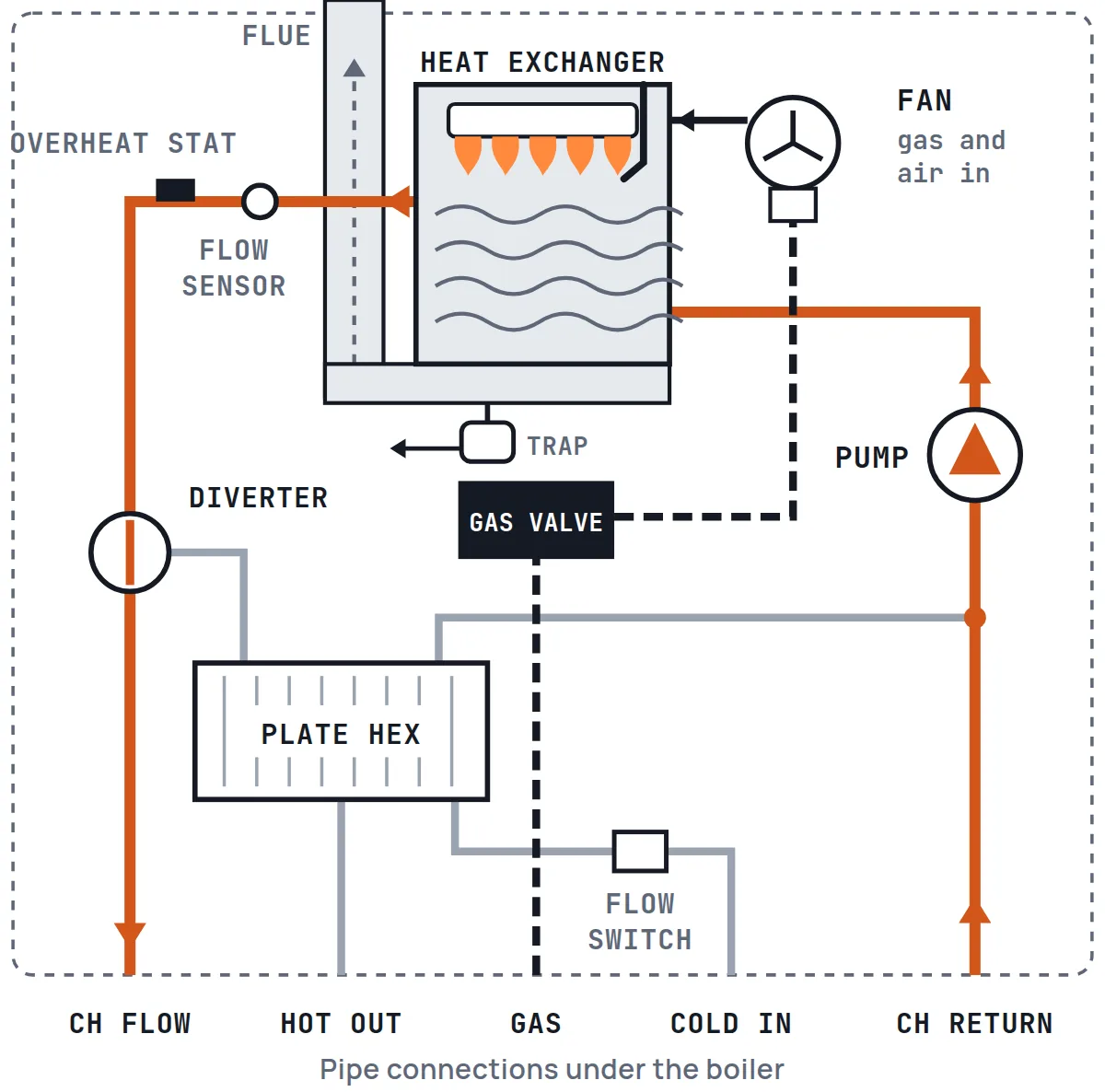
Heating call. The pump pushes water up through the heat exchanger. The diverter sends it out to the radiators. The plate heat exchanger sits idle.
Don't be fooled by
- Frost protection. It fires with no call when the flow sensor reads very cold, usually around 5 to 7 °C, then stops once it's warm.
- Pump and fan overrun. Both carry on after the burner stops. Normal, not a fault.
- Pump and diverter exercise. Some boilers kick them once a day so they don't seize.
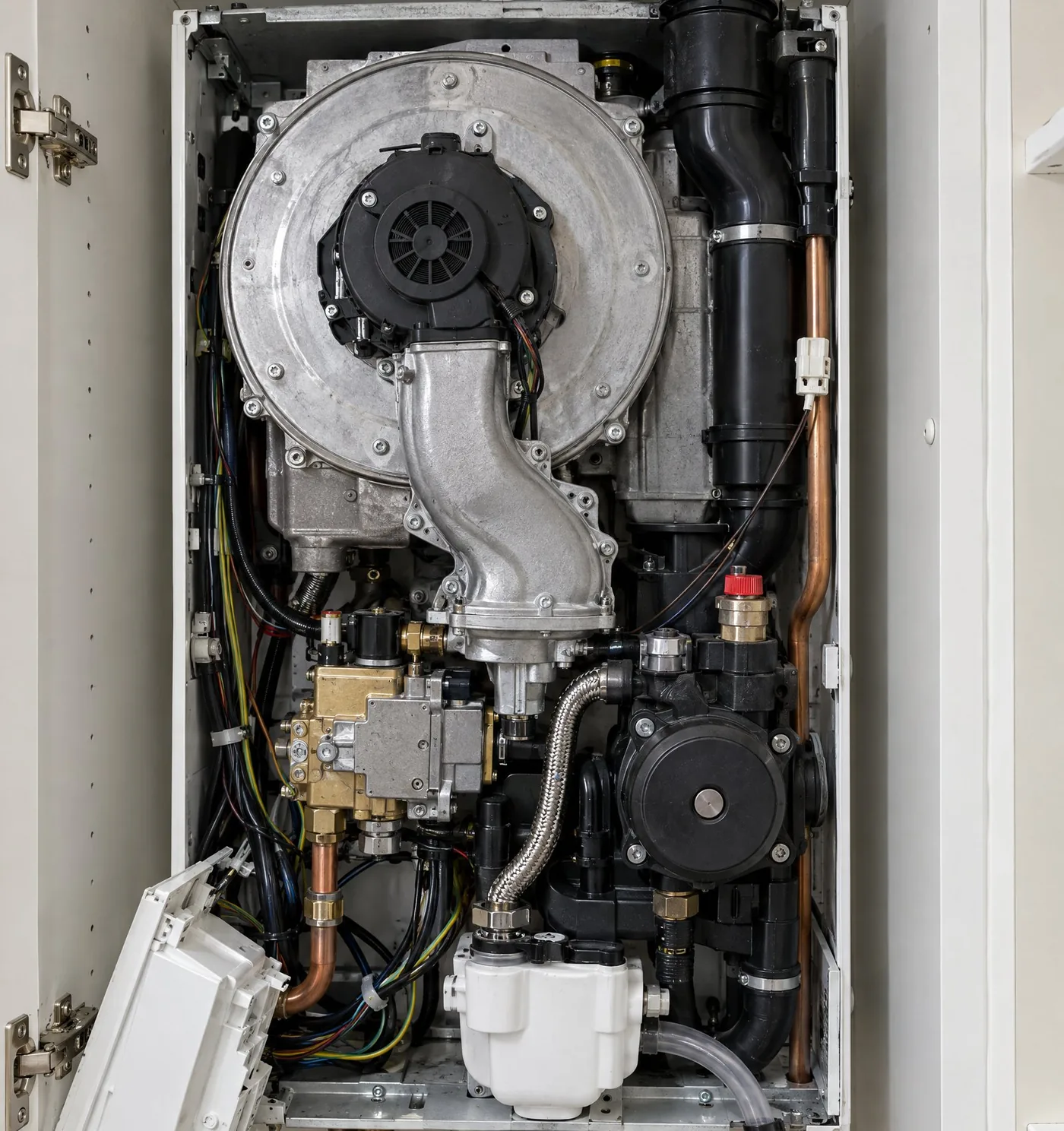
Illustration. Case off. 1 heat exchanger, burner door on its front, 2 fan, 3 gas valve, 4 pump, 5 condensate trap, 6 control box, folded down, 7 temperature sensor. Layouts vary by make.
The hot water call
Step by step
- Tap opens. A flow switch or flow turbine on the cold main sees water moving. Some ranges need more than 2 litres a minute before it starts.
- Pump on, diverter to hot water. No pre-circulation on a hot water call: it lights as fast as it can.
- Fan, spark, flame proved. The same as a heating call. Both overheat checks and both sensors have to read right.
- Short settle, then modulates. A shorter settle at low rate than on heating, then the burner follows the hot water sensor and the flow rate to hold the set temperature.
- Tap closed. Burner off, overrun, and the diverter goes back to heating.
Flow switches come as a paddle and microswitch, a turbine, a wheel, or a pressure differential switch. Chapter 5 has what goes wrong with each.
Use the sequence to find the fault
Each step waits for proof that the one before it worked. Missing proof, and the sequence stops at that step. So watch it: does the pump start, does the fan run, is there a spark, does the flame hold? The step where it stops is the part you test.
Many boilers show the step they're on as a status code in the display or service menu. Look the codes up in Flint for the boiler in front of you.
Let one call test the other
If hot water works and heating doesn't, the hot water call has just proved the fan, the pump, the spark, the flame sensing and the gas valve. What's left is what only the heating uses: the diverter's heating side, the primary flow switch, the heating sensor, the heating call and the PCB. The same works the other way round. Chapter 5 turns this into a flowchart.
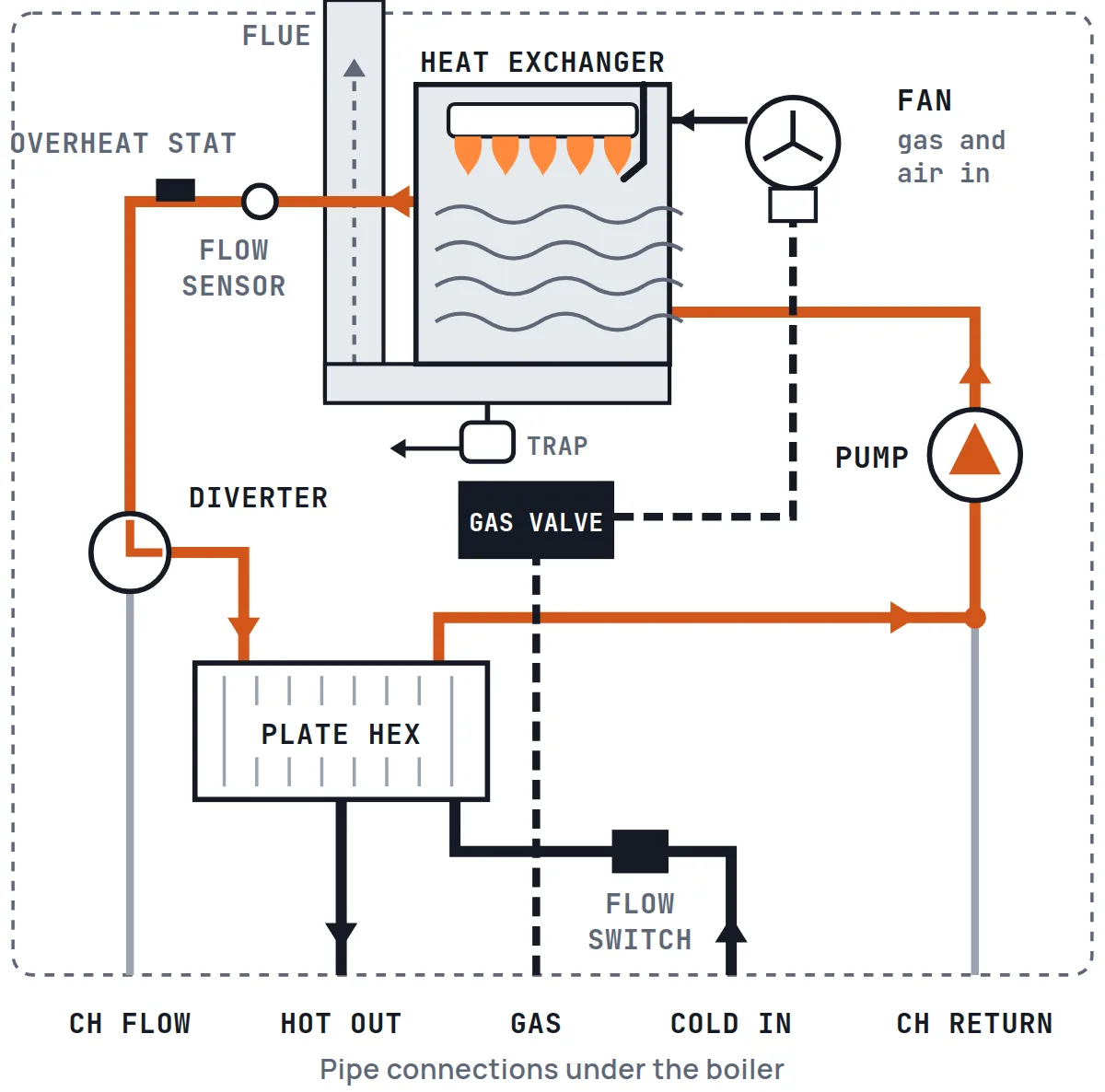
Hot water call. The diverter sends the hot primary water through the plate heat exchanger and back to the pump. Mains water picks up the heat on the other side of the plates on its way to the tap.
Keep-hot and preheat
Some combis keep the plate heat exchanger warm so hot water arrives sooner. They fire for a few minutes with no tap open, then stop. Customers report it as the boiler "coming on by itself". Check the preheat setting before you go looking for a fault.
Diverter valve: stuck or slow
Signs: hot water runs cold or lukewarm while the radiators warm up, or heating works and hot water doesn’t. On a hot water call the diverter should send the primary water through the plate heat exchanger. Stuck, it sends it round the heating instead.
- Motor head type: on a hot water call, AC volts at the head’s plug. Supply there and the spindle not moving: replace the head.
- Head moves but the flow doesn’t change: the spindle or cartridge is seized or worn. Isolate and drain down, then free or replace the cartridge.
- Water-driven types have no motor. Check the flow and the filter, then the cartridge.
Free guide
Get Fault Finding Basics as a PDF
This lesson is part of Fault Finding Basics, our free 26-page guide: safe isolation, your meter, how a combi works and the five tests that find most faults. Add your email and it comes straight over.
Send me the guideWant every test? The Flint Field Guide has all 56 chapters with a video for every test. £97 once, updates included.
For competent, Gas Safe registered engineers. Isolate and prove dead before any electrical test. Always work to the manufacturer's instructions and the current standards, and check every figure against the appliance data badge and manual.