Home Fault finding
Fault finding
Boiler fault finding for gas engineers
The tests, in the order you'd do them on site, with the readings to expect. These lessons are the free part of the Flint fault finding course, written by a working Gas Safe engineer.
The five tests that find most faults
A sensor, the fan, the pump, the gas valve and the ignition. Between them they stop most boilers that won't run.
The code points, the meter proves
A fault code tells you which step of the sequence failed. It doesn't tell you which part. A fan fault can be the fan, its plug, the loom or the PCB that drives it. Test before you order: a part fitted on a guess is the dearest test there is.
Read the service menu first
Most modern boilers show live readings in a service or info menu: flow and return temperatures, system pressure, fan speed against target speed, the flame signal. They cost nothing to read and need no leads on anything. A sensor showing 85 °C on a cold pipe has told you where to look.
Every test, every time
- Isolate, prove dead, lock off. Chapter 1, before any dead test.
- Unplug the part at its own plug. Leave it plugged in and you measure the loom and the PCB as well.
- Check the meter. Probes together: zero on ohms, a beep on continuity.
- Compare with the manufacturer's figure for that boiler, in Flint. The figures in this guide show you what normal looks like.
- Check the loom before the part. Wiggle the plug, test each wire end to end.
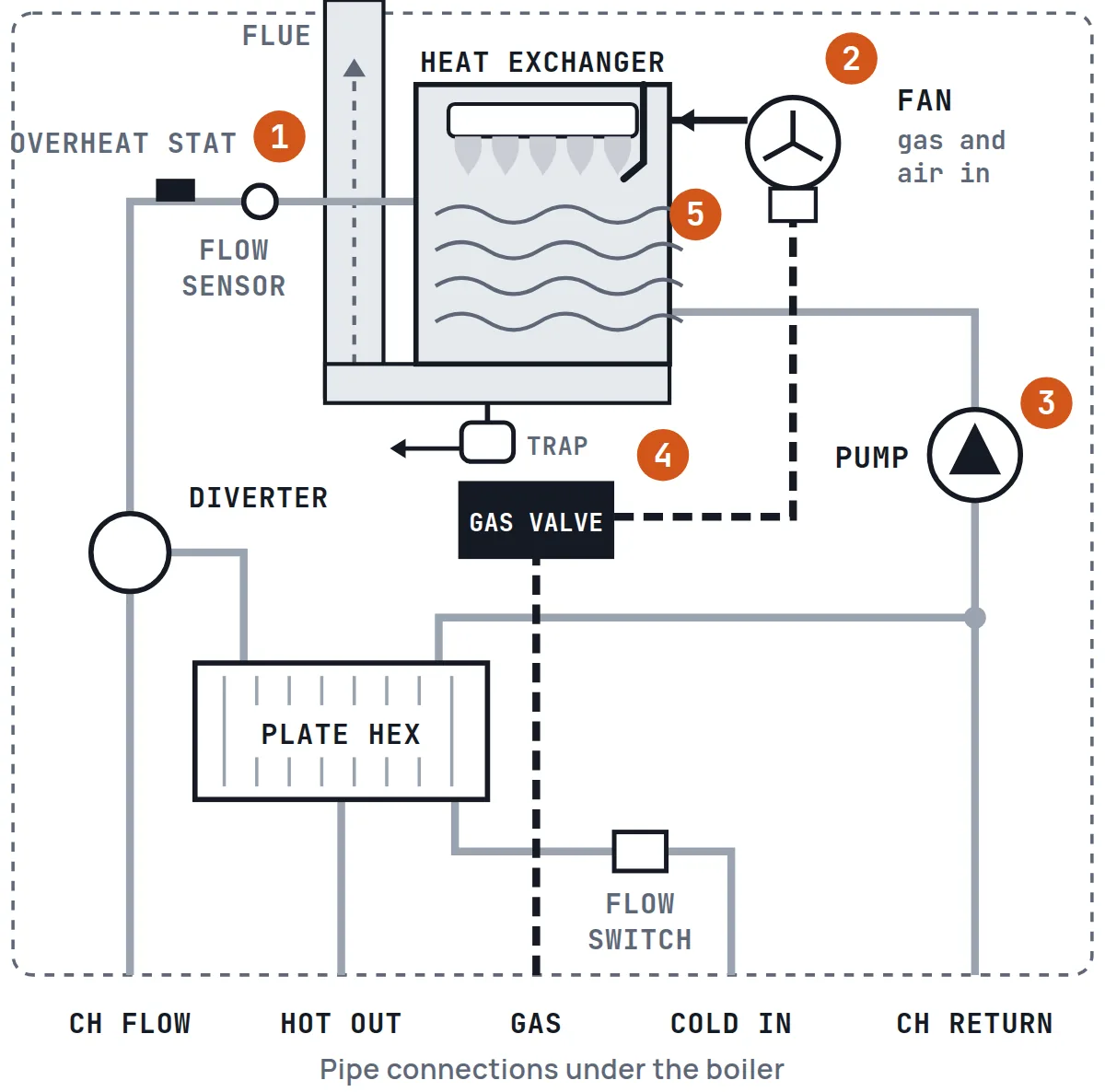
Where the five parts sit in a typical combi. Layouts vary by make; the parts don't.
| The five tests | ||
|---|---|---|
| 1 · Sensor | Ohms against temperature | 11 |
| 2 · Fan | Supply, spin, windings or signal | 12 |
| 3 · Pump | Supply, rotor, windings or signal | 13 |
| 4 · Gas valve | Coil voltage, then coil ohms | 14 |
| 5 · Ignition | Spark, gap, flame current | 15 |
The fault code, then the test
Search the code for the boiler on the wall. Flint shows what the manufacturer says it means and the readings for the parts involved, with the manual page.
The lessons
The full course
These lessons are the free part. The Flint Field Guide is the whole course: all 56 chapters, from controls and wiring to heat exchangers and PCBs, with a video for every test. Read it on learn.flintfix.com and download your own PDF. £97 once, updates included.
Free guide
Get Fault Finding Basics as a PDF
This lesson is part of Fault Finding Basics, our free 26-page guide: safe isolation, your meter, how a combi works and the five tests that find most faults. Add your email and it comes straight over.
Send me the guideWant every test? The Flint Field Guide has all 56 chapters with a video for every test. £97 once, updates included.
For competent, Gas Safe registered engineers. Isolate and prove dead before any electrical test. Always work to the manufacturer's instructions and the current standards, and check every figure against the appliance data badge and manual.