Home Fault finding Boiler no heating or no hot water: where to start
Fault finding
Boiler no heating or no hot water: where to start
Start from what the customer tells you, then work down the page. If one side still works, it has already ruled half the boiler out.
No heating, no hot water, or neither
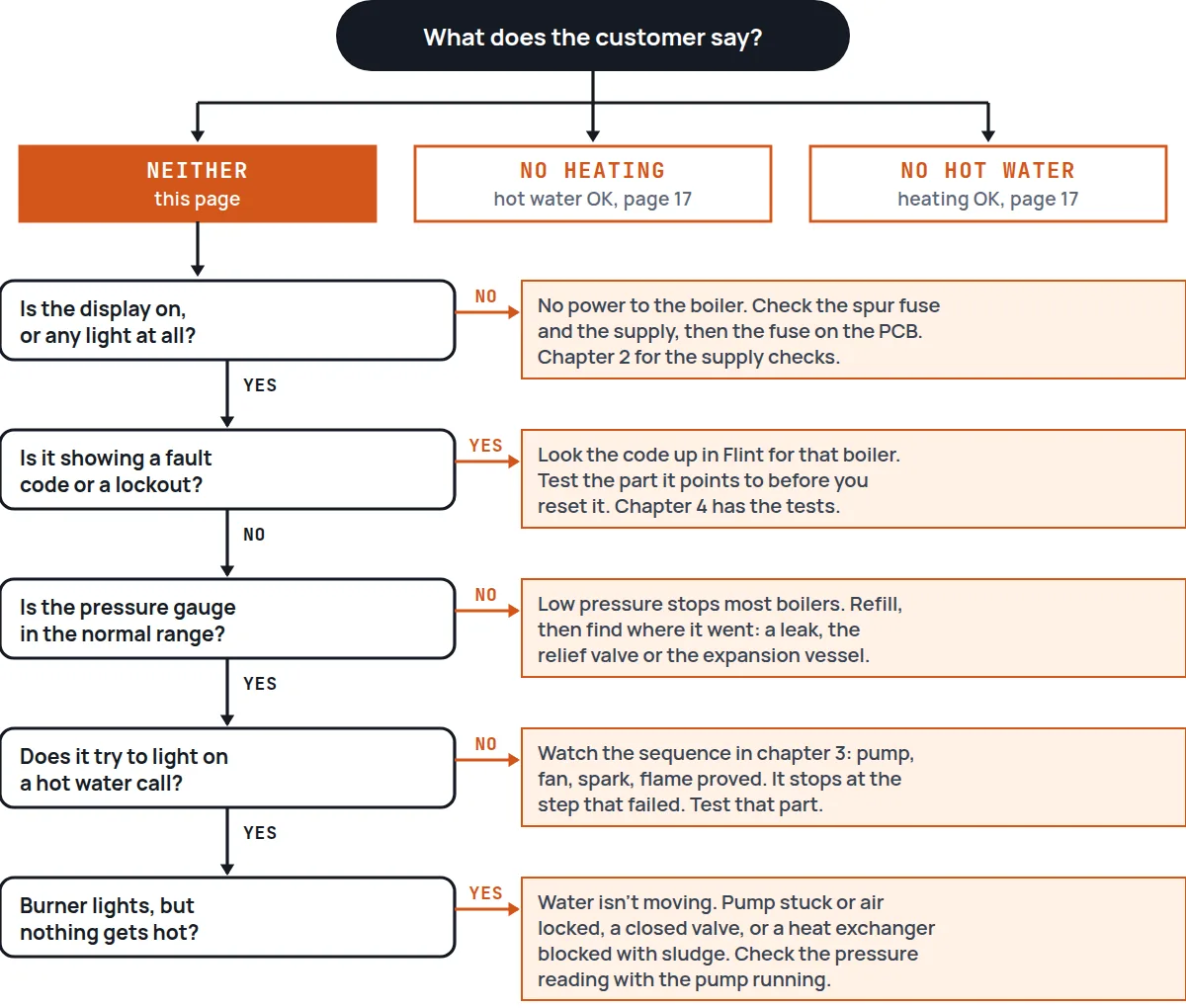
Ask before you open it
- When did it stop, and did anything happen first? A power cut, or someone topping up the pressure?
- Every time, or now and then? Has anyone else been out to it?
- What does the display say? Photograph it before you reset anything.
Before you reset a lockout
A reset clears the evidence. Write down the code and the pressure first. Then reset once and watch the whole sequence (chapter 3). Reset after reset on a lockout you haven't found is how a boiler gets left unsafe.
Pressure keeps dropping
- Top up to the manufacturer’s figure, then check again in a day.
- Look for the leak: valves, joints, the filling loop, and the relief valve’s discharge pipe outside.
- Relief valve lifting hot: the expansion vessel. Isolate and drain it, then press the air valve. Water out: split diaphragm. Air only: re-charge it to the figure on its label.
Pressure keeps rising
- Filling loop letting by: close both valves, disconnect the hose.
- Rises hot and the relief valve lifts: the expansion vessel again.
- Combi, loop disconnected, still rising: a pinhole in the plate heat exchanger.
When one side still works
Stop.
The working side has already tested half the boiler. If either heating or hot water works, the fan, the pump, the spark, the flame sensing and the gas valve are proven. Look only at what the broken side uses on its own.
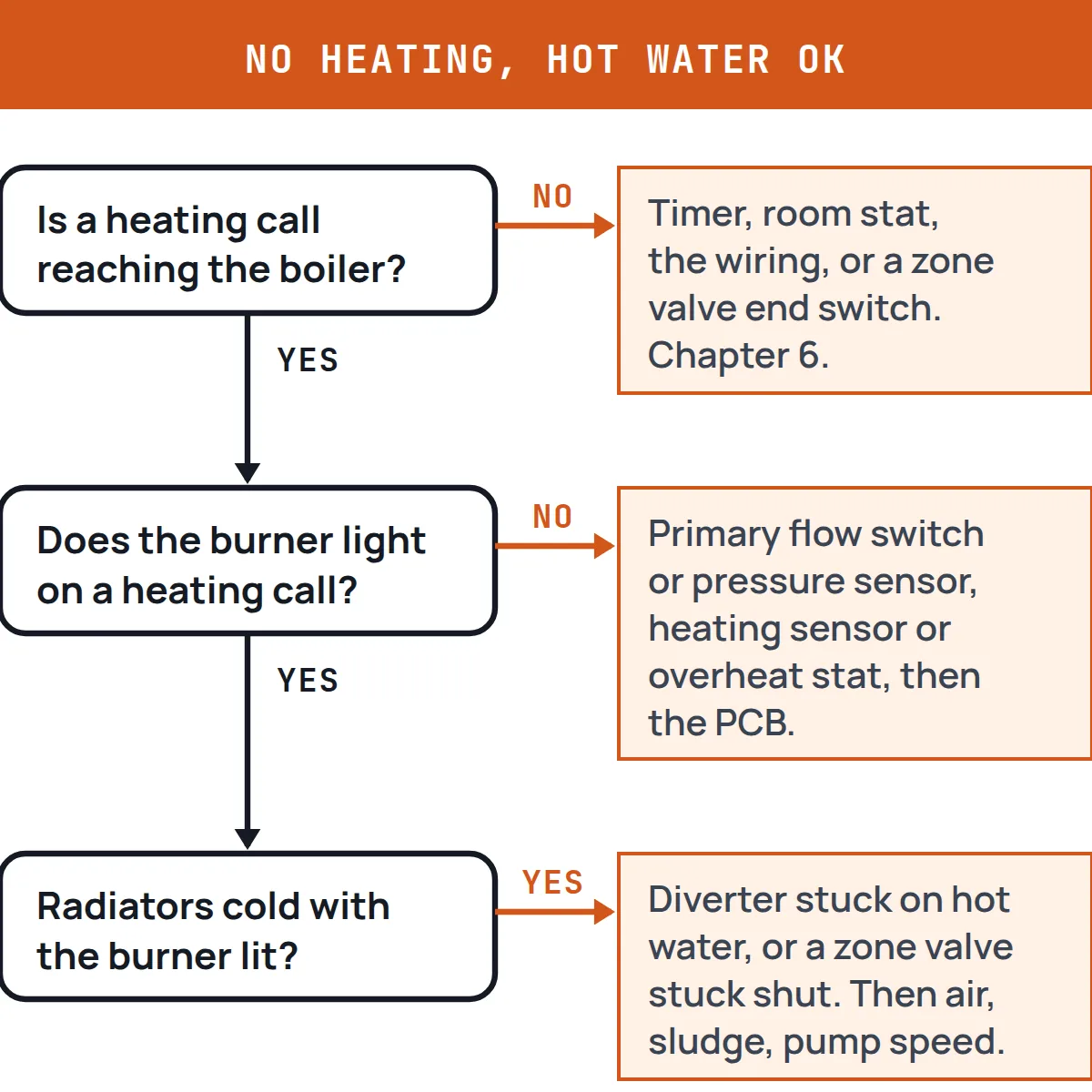
System and regular boilers: no heating
- Room stat stuck satisfied, or the programmer's heating channel off
- Zone valve or mid-position valve seized with port A shut (chapter 6)
- Heating zone valve end switch not making, so the boiler is never asked
- Pump weak or seized, heat exchanger blocked, sensor or overheat stat open
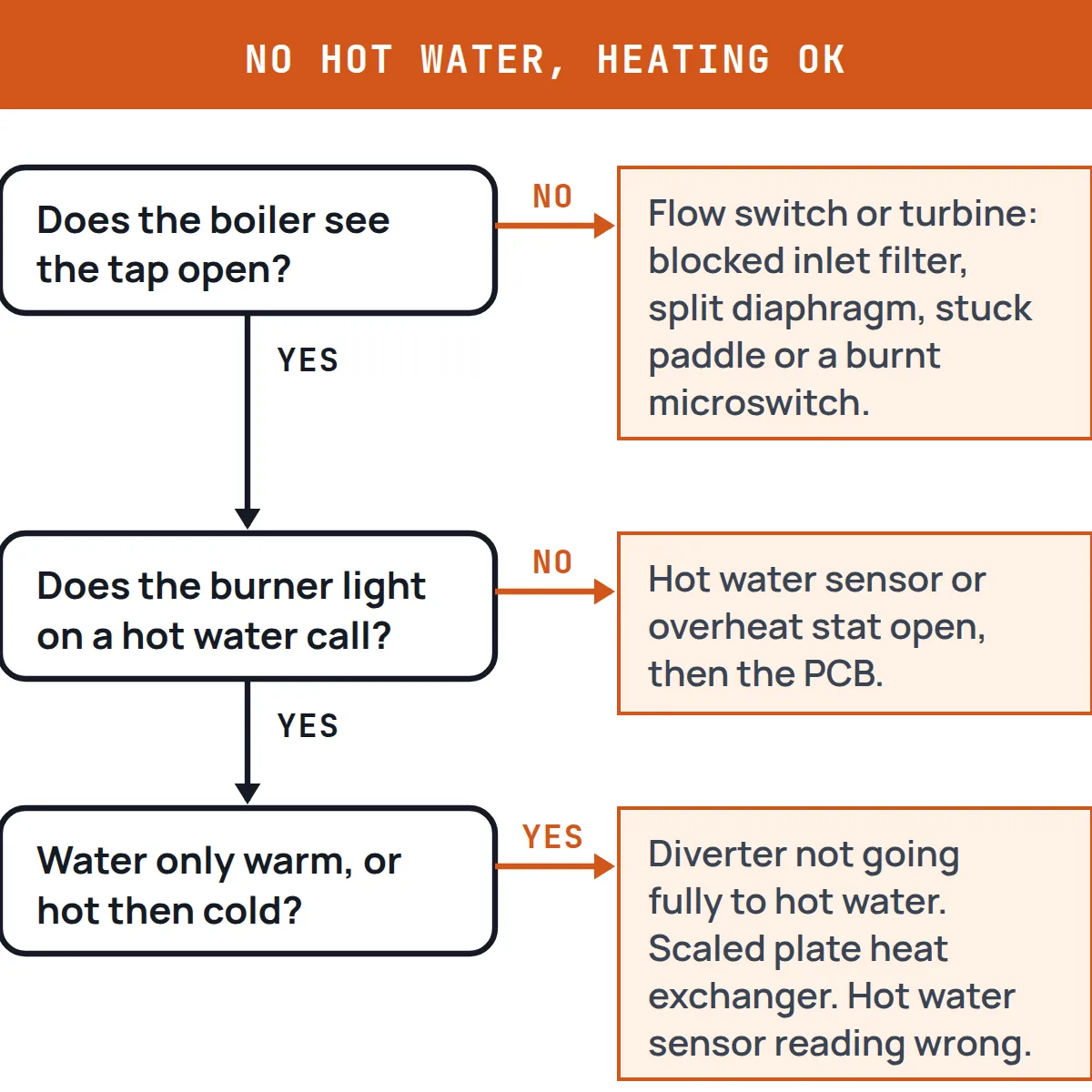
System and regular boilers: no hot water
- Cylinder stat stuck satisfied, or the programmer's hot water channel off
- Zone valve or mid-position valve seized with port B shut
- Hot water zone valve end switch not making
- Weak pump, or a sensor or overheat stat open
Worked example: a combi with hot water but no heating
- Hot water works. Fan, pump, spark, flame sensing and gas valve are proven. Don't test them.
- Live Is the call reaching it? Switched live at the boiler's heating terminal with the stat turned up: about 230 V.
- No call. Check the boiler manual first: the call terminals must be a switched 230 V live or a plain volt-free link, not a low-voltage or digital stat connection. Isolate, take the external wiring off and link them, then power up. It fires: the fault is in the stat, the timer or the wiring.
- Call there, no burner. Primary flow switch, heating sensor, then the PCB.
Condensate blocked or frozen
- Locks out or won’t fire in a cold snap, or gurgles. Check the outside run first: ice in the pipe is the usual cause. Thaw it with warm water, never boiling.
- Isolate, clean the trap and refit it with water in.
- The run must fall all the way to the drain. Outside it wants 30 mm bore or more, as short as you can, lagged. A run through a garage or loft counts as outside.
Before you condemn a PCB
- Boards are rarely the fault. Prove everything it controls first.
- Live, neutral and earth at the board, then its fuses, connectors and loom. Look for burn marks, green corrosion or damp.
- Condemn it only when every input is right and an output is still missing. A new board may need the boiler type set.
Free guide
Get Fault Finding Basics as a PDF
This lesson is part of Fault Finding Basics, our free 26-page guide: safe isolation, your meter, how a combi works and the five tests that find most faults. Add your email and it comes straight over.
Send me the guideWant every test? The Flint Field Guide has all 56 chapters with a video for every test. £97 once, updates included.
For competent, Gas Safe registered engineers. Isolate and prove dead before any electrical test. Always work to the manufacturer's instructions and the current standards, and check every figure against the appliance data badge and manual.