Home Fault finding How to test a boiler fan
Fault finding
How to test a boiler fan
Fault finding a boiler fan: the supply, the speed signal and the fan itself, tested in order with a multimeter, and what each reading tells you to change.
What it does
The fan pushes air through the burner and the products out of the flue. The boiler won't light until it has proof the fan is running: a speed signal back from the fan on modern boilers, an air pressure switch on older ones.
Older fans run on 230 V AC. Most modern fans are DC, driven by a speed signal from the PCB and sending speed pulses back.
Symptoms when it fails
- Fan fault code or lockout, and the fan never starts
- Fan runs but the boiler won't light
- Rumbling or whining from the fan
- Lights, then cuts out on an air or fan fault
How to test it
- Safely isolate the boiler (chapter 1). Take the case off.
- Spin the impeller by hand. Stiff, rough, rubbing or noisy means bearings, or the rotor catching the case.
- Live Mains fan Supply. Heating calling, AC volts at the fan, L to N. About 230 V and a free impeller but no movement: the windings have gone.
- Live DC fan Supply and signal. DC volts at the fan plug: a steady supply, and a speed signal that is there before the fan turns and dips as it starts. Figures vary by make.
- DC fan Speed. In the service menu, does actual speed follow target speed? Signal there, no movement: check the speed feedback, then the fan.
- Isolate again. Lock off and prove dead.
- Mains fan Windings. Wires off, ohms, L to N. Compare with the readings opposite.
- Speed resistor, if fitted. Leads off, ohms across it. Any reading is fine, OL is faulty.
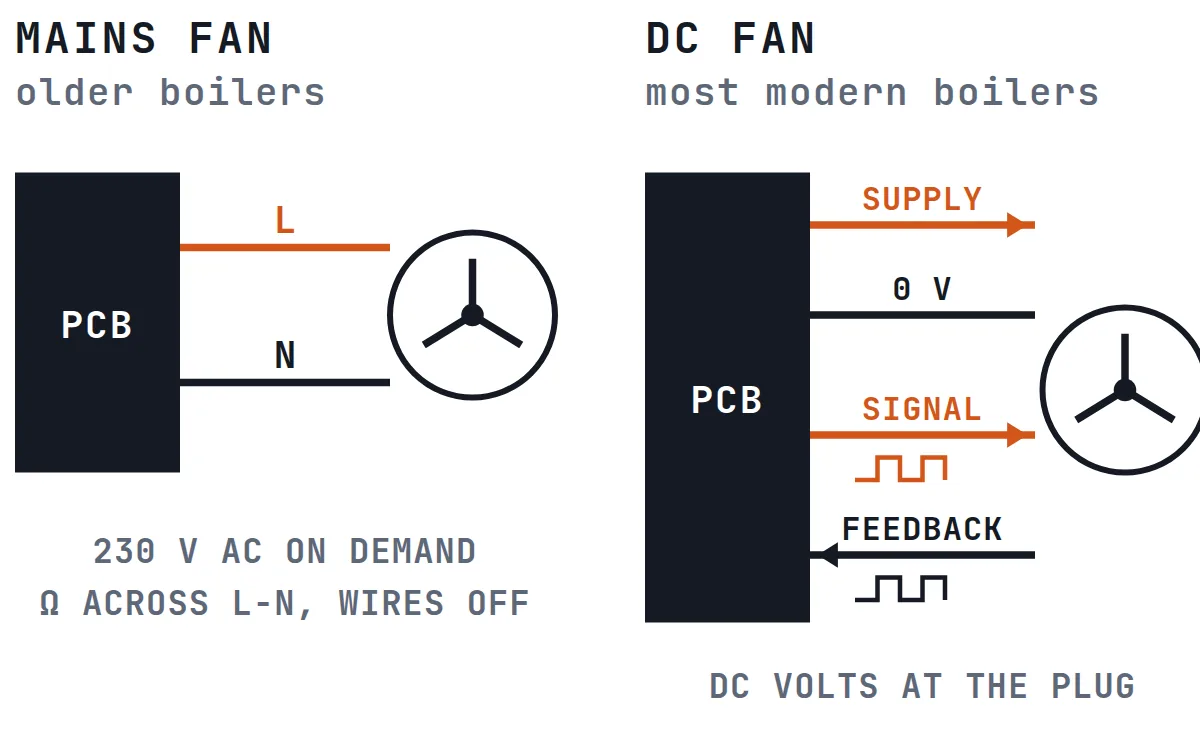
A mains fan has a live and a neutral. A DC fan has a supply, a 0 V, a speed signal in and speed pulses back.
Typical readings
Figures vary by model. Go by the manufacturer’s figure for the boiler in front of you.
| Supply L to N · calling Mains fan | |
|---|---|
| About 230 V | The PCB is asking for the fan. |
| 0 V | Not being asked. PCB output, its fuse, the loom. |
| Windings L to N · wires off Mains fan | |
| 30 to 100 Ω | Normal for most mains fans. |
| Under 20 Ω | Burnt windings. Replace. |
| OL | Open circuit. Replace. |
| Speed · running DC fan | |
| Actual = target | Fan and feedback OK. |
| Signal, no speed | Feedback lead, then the fan. |
| Feedback | Pulses that rise with speed, for example 36 Hz at 1,100 rpm. |
Common failures
Worn bearings. Noisy, or the impeller is out of balance. Replace the fan.
Rotor catching the case. Heat and wear move it. Sometimes it can be reset, often not.
Impeller fouled. Dust or debris. Slows it until the boiler won't prove it.
Slow fan on an air pressure switch boiler. The switch doesn't make. The fault is the fan. To prove the switch: tubes off, call for heat, the fan runs and nothing lights. Tubes on, it lights. Tubes off while it runs, the burner goes out.
Speed resistor or plug. Burnt, melted or loose. Higher resistance, slower fan.
Penetrating spray on a stiff rotor. It's a degreaser, not a fix. Replace the fan.
Free guide
Get Fault Finding Basics as a PDF
This lesson is part of Fault Finding Basics, our free 26-page guide: safe isolation, your meter, how a combi works and the five tests that find most faults. Add your email and it comes straight over.
Send me the guideWant every test? The Flint Field Guide has all 56 chapters with a video for every test. £97 once, updates included.
For competent, Gas Safe registered engineers. Isolate and prove dead before any electrical test. Always work to the manufacturer's instructions and the current standards, and check every figure against the appliance data badge and manual.