Home Fault finding How to test a boiler gas valve
Fault finding
How to test a boiler gas valve
Testing a boiler gas valve: the inlet working pressure, the voltage at the coil, coil resistance and pin to body, in the order that finds the fault fastest.
What it does
The gas valve opens when the PCB energises its coils and shuts the moment they drop out. Most have two shut-off stages in a row, so one sticking open still leaves the gas off.
On older boilers a separate modulating coil sets the gas rate. On most modern boilers the valve follows the fan: more air through the venturi, more gas. That is why fan and gas faults can look alike.
Symptoms when it fails
- Sparks, but never lights, then locks out
- Lights, then drops out after a few seconds
- Stuck on high or low rate
- Gas smell at the valve: an escape is Immediately Dangerous. Gas off, then follow the unsafe situations procedure
How to test it
- Rule out the gas first. Gas on at the meter and the appliance. Working pressure at the valve inlet against the manufacturer's figure (chapter 8).
- Live Voltage at the coil. During ignition, at the valve plug: AC or DC, to suit the valve. No voltage: PCB or loom, not the valve.
- Isolate. Lock off and prove dead. Turn the gas off at the appliance valve.
- Coil resistance. Plug off, ohms across each coil in turn. Compare with the figure for that valve.
- Pin to body. Ohms from each pin to the valve body or earth pin. Any reading is a fault.
- Voltage right, coils right, still no gas? The valve is sticking. Replace it.
- After any gas valve work: tightness test, check the gas rate, then CO and the ratio at maximum and at minimum rate before you leave.
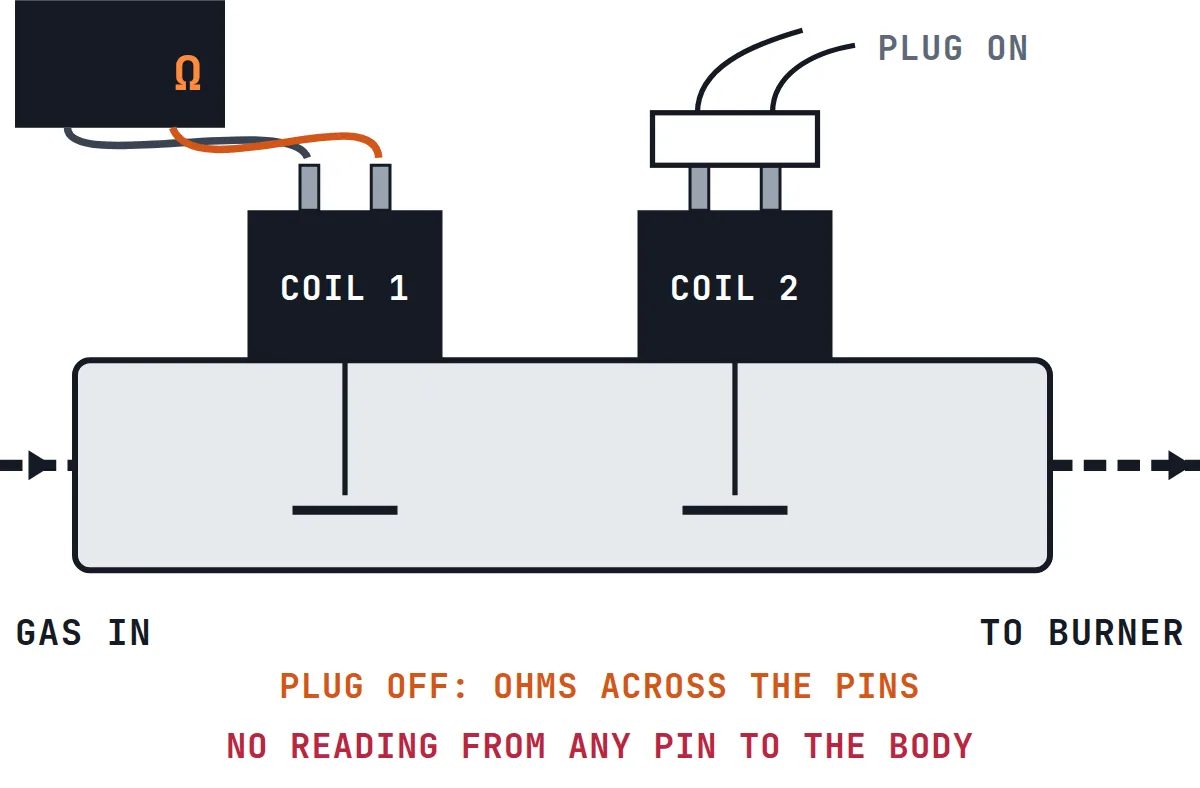
Two shut-off coils in a row. Test each coil on its own with its plug off.
Typical readings
Coil figures vary by valve, from tens of Ω to several kΩ. Use the manufacturer’s figure for that valve.
| Coil resistance · plug off | |
|---|---|
| Manufacturer’s figure | Close to it: coil OK. |
| Near 0 Ω | Shorted coil. Replace. |
| OL | Open coil. Replace. |
| Coil voltage · during ignition | |
| AC or DC | Mains AC or low-voltage DC, often 24 V. Check the coil label. |
| Drops | Some DC valves open higher, then hold lower. Varies by model. |
| 0 V | Not being asked. PCB output or loom. |
| Pin to body · ohms | |
| OL | OK. |
| Any reading | Leaking to earth. Replace. |
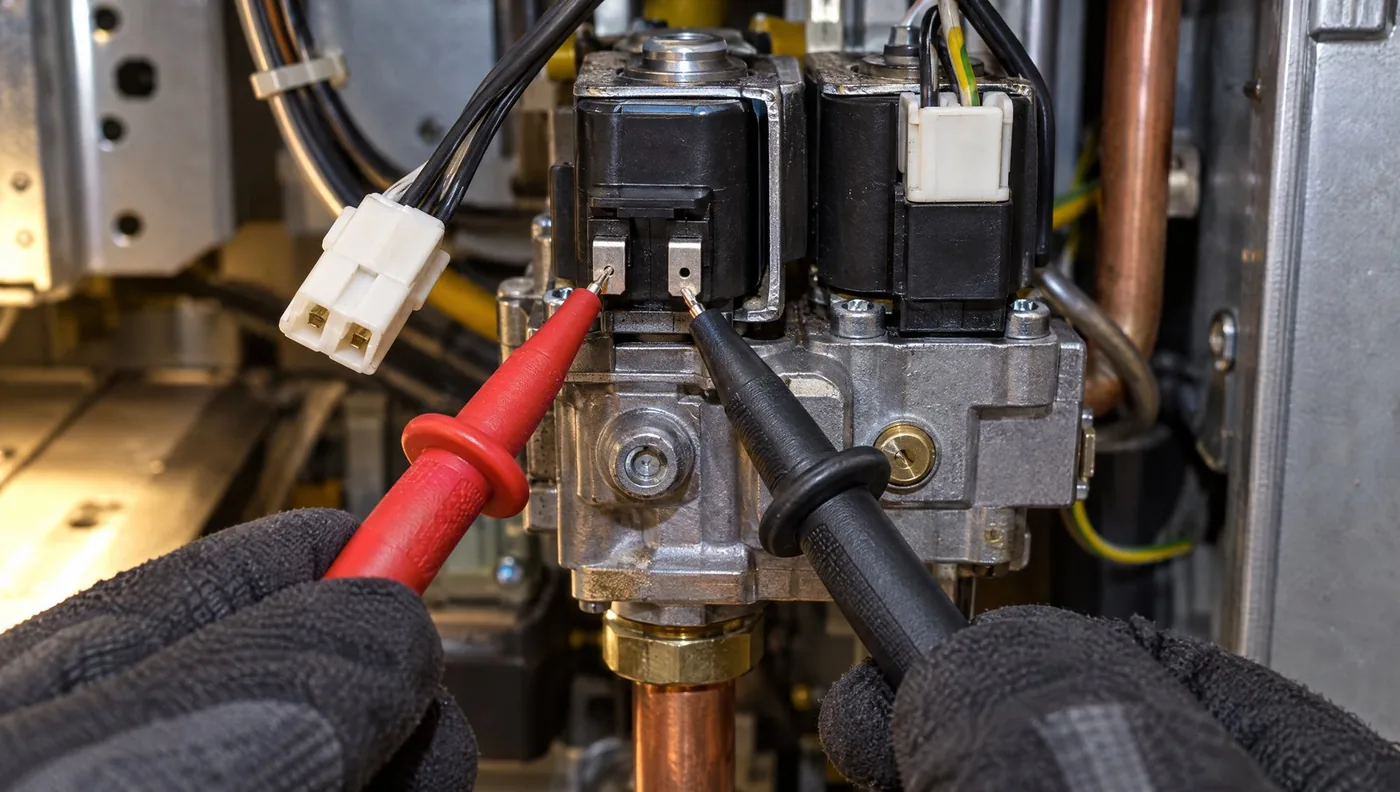
Illustration. Plug off one coil, a probe on each pin.
Common failures
Burnt coil. Reads open circuit. No gas on demand.
Poor terminal or plug. Works when you wiggle it. Check the pins and the loom.
Debris in the valve. The plunger sticks. Lights some days and not others.
Adjusted by someone before you. Don't touch the offset or throttle unless the manufacturer's instructions or helpline tell you to, and then only with an analyser.
Free guide
Get Fault Finding Basics as a PDF
This lesson is part of Fault Finding Basics, our free 26-page guide: safe isolation, your meter, how a combi works and the five tests that find most faults. Add your email and it comes straight over.
Send me the guideWant every test? The Flint Field Guide has all 56 chapters with a video for every test. £97 once, updates included.
For competent, Gas Safe registered engineers. Isolate and prove dead before any electrical test. Always work to the manufacturer's instructions and the current standards, and check every figure against the appliance data badge and manual.